
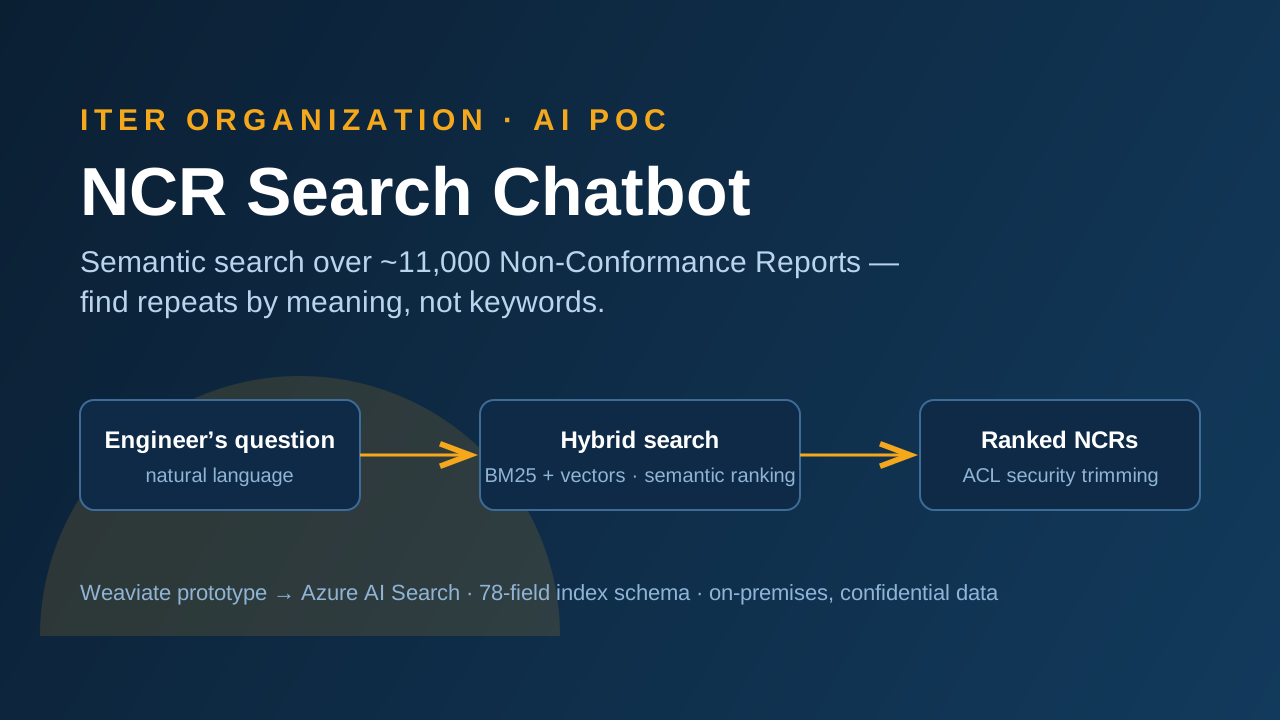
NCR Search Chatbot — ITER Organization
An AI chatbot that lets ITER engineers search ~11,000 Non-Conformance Reports by meaning instead of keywords, built during my AI POC internship.
Timeline
July 2026 – Present
Role
AI POC Intern
Team
ITER Organization (with supervisor)
Status
In-progressTechnology Stack
Key Challenges
- Confidential data with an on-premises requirement
- Missing long-text fields in the database extract forced an ingestion redesign
- ACL-based security trimming so users only see reports they are allowed to
- Mapping a 78-field index schema from the enterprise database
- Balancing speed vs accuracy in vector search (HNSW tuning)
Key Learnings
- Real company data is messy — confidentiality rules shape architecture more than model choice
- Benchmarking HNSW parameters (ef, efConstruction, maxConnections)
- Hybrid BM25 + vector retrieval with semantic ranking
- Explaining vector search to nuclear engineers taught me more than building it
Overview
ITER is the world's largest fusion energy project. Over the years of manufacturing and construction it has accumulated roughly 11,000 Non-Conformance Reports (NCRs) — records of things that went wrong along the way.
Procedure says that if the same issue repeats more than twice, it must be escalated. The catch: finding those repeats depended almost entirely on people's memory. My internship project is about integrating AI into ITER's existing systems so engineers can search these reports by meaning, not keywords.
What I Built
Weaviate Prototype
I first prototyped the full pipeline on Weaviate:
- Ingestion of the NCR corpus
- Embedding generation
- Semantic search over the reports
To understand the speed vs accuracy trade-offs, I benchmarked HNSW parameters — ef, efConstruction and maxConnections — and measured how each affected recall and latency.
Azure AI Search Architecture
Together with my supervisor, I then redesigned the architecture on Azure AI Search:
- Hybrid retrieval — BM25 keyword search combined with vector search
- Semantic ranking on top of the hybrid results
- A 78-field index schema that I mapped from the enterprise database
Real-World Constraints
This is where the project stopped feeling like a tutorial:
- Confidential data — an on-premises requirement shaped what infrastructure was even allowed
- Missing long-text fields in the database extract forced a redesign of the ingestion pipeline
- ACL-based security trimming ensures users only ever see the reports they are authorised to access
What I Learned
Real company data is messy, and confidentiality rules shape the architecture more than model choice does. And honestly — explaining vector search to nuclear engineers taught me more than building it.
Links
Internal project (confidential data) — an architecture write-up is available on request.